AI trading and IA trading: the same concept in two languages
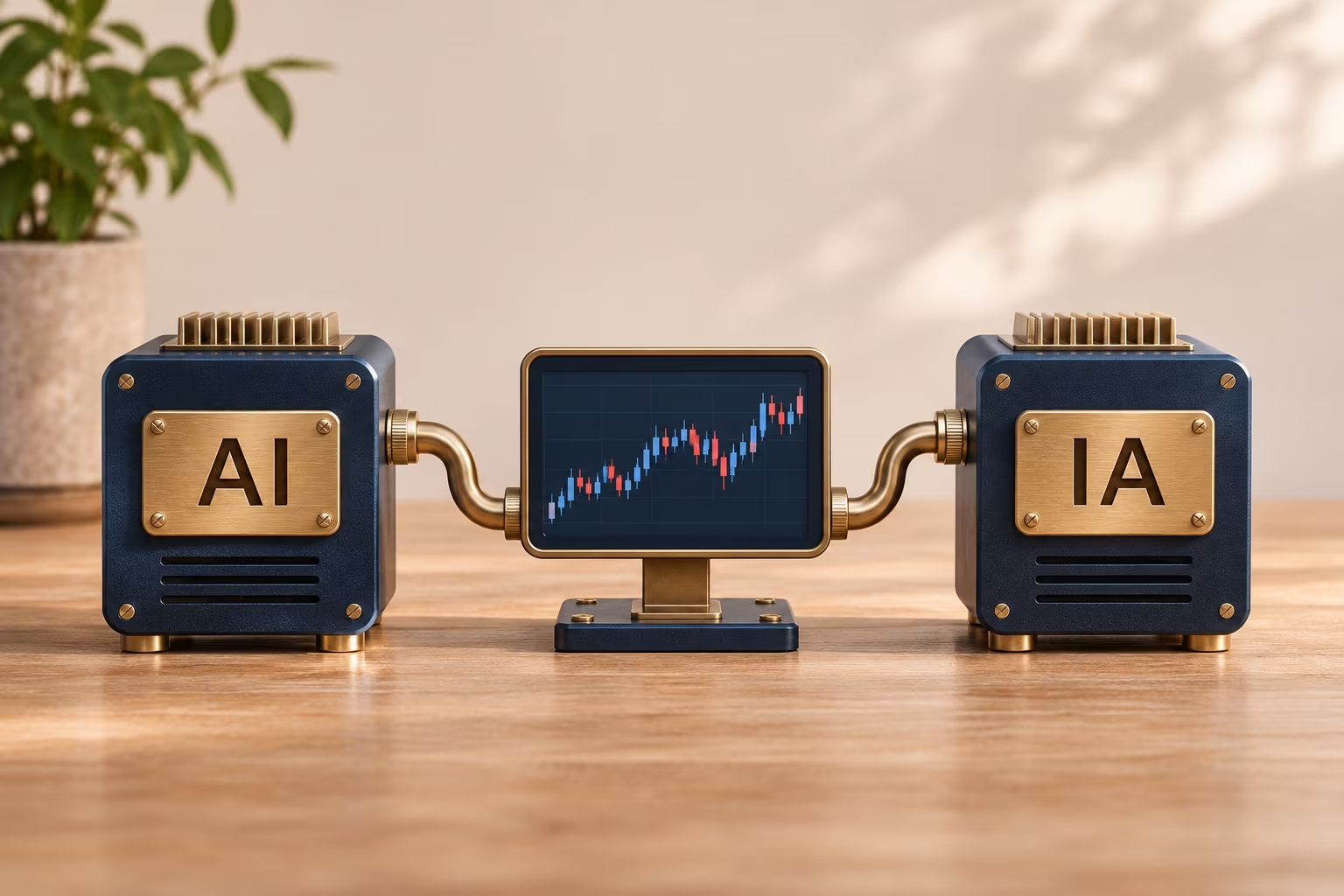
AI trading and IA trading mean the same thing. Both expressions refer to the use of artificial intelligence to analyze the market and execute trades; the only difference is the language of the acronym—AI in English and IA in Spanish.
What AI trading provides is the ability to process large amounts of data simultaneously and detect patterns that a person would miss. What it does not provide is certainty about price movements or protection against losses.
Why AI trading is written in two ways
Trading vocabulary is international, and in Spanish, English terms coexist with their translations. The same applies to artificial intelligence. Those searching for information in Spanish sometimes write "AI trading" because that is how it appears on platforms, with brokers, and in product names, and sometimes "IA trading" because it is the standard acronym in Spanish.
Both forms are correct, and we use them interchangeably on this blog. The same applies to other terms in the sector:
- AI trading or IA trading. The general approach of trading with the support of artificial intelligence.
- AI trader or IA trader. The system that analyzes the market and decides when to act.
- Trading bot or bot de trading. The program that executes orders in the account.
- Trading con IA or trading con inteligencia artificial. The most descriptive forms, common in educational texts.
What matters is knowing what each term refers to, because they are frequently mixed up, and that confusion is the source of many misguided expectations.
AI trading, AI trader, and trading bot: three parts of the same system
The three terms appear together and are often used as synonyms. Each designates a different part:
AI trading is the broad concept. The AI trader and the bot are two of its components: one that thinks and one that executes. A service might have a very reliable bot but very poor analysis, or vice versa, which is why you should ask about each piece separately.
What AI does versus what fixed rules do
In a well-designed AI trading system, artificial intelligence does not decide everything. In the case of Boosty, the division is as follows:
Fixed rules cover precisely what can cause the most damage if left to improvisation:
- Predefined stop loss and take profit. Each trade is opened with its exit levels already set.
- Limited risk per trade. It is around 1% of the balance of each account.
- Size adjusted to capital. The volume of each trade is calculated based on the balance, both up and down.
The reason for this division is practical. Market analysis requires flexibility because the market changes. Risk management requires the opposite, because it is what protects the account when the analysis is wrong—and the analysis is wrong sometimes. A system in which the AI also decided how much to risk at any given moment would be more difficult to supervise and understand.
This combination of adaptive analysis and fixed rules is also what separates an AI system from a classic bot that only follows rules. We explain this in more detail in AI automated trading vs. a classic bot.
What it means to detect market patterns
"Detecting complex patterns" might sound abstract. In trading, it usually refers to combinations of conditions that a simple rule cannot capture, for example:
- Relationships between assets. How one currency pair moves in relation to others that usually move in the same or opposite direction.
- Volatility shifts. Moments when the market transitions from low movement to high movement, or vice versa.
- Time-based behavior. Differences in how price reacts depending on which market session is open.
- Multiple signals at once. Situations where no single condition is sufficient on its own, but their combination fits the strategy.
A fixed rule like "buy if the price exceeds this level" captures none of that. A model that processes large amounts of data simultaneously can, and that is its real contribution. Detecting a pattern does not guarantee it will repeat, which is why risk is managed separately.
What AI trading looks like day-to-day
From the outside, AI trading is much less spectacular than industry advertising suggests. In the case of Boosty:
- Analysis never stops. The system monitors the market 24 hours a day, Monday through Friday.
- Execution is selective. Trades are opened when a valid opportunity arises, without a fixed schedule.
- What you see is your history. Trades are recorded in the broker with all their data, from the opening time to the result.
- There are days without trades. If conditions do not align with the strategy, the system does not trade.
That is why one of the most common questions during the first week in the Boosty Telegram channel is whether the system trades 24 hours a day. It analyzes all day, but only trades when conditions justify it. Those who expect to see constant trading often interpret quiet days as a failure, when they are actually part of the design.
What a full day with the system connected looks like, from start to finish, is covered in a day with the active system. And if you want to see how it connects to an account and what steps to follow to get started, it is explained in the Boosty AI trader.
AI trading applied to the currency market
Forex is one of the markets where AI trading is most widely used, due to three characteristics that fit well with automated analysis:
- It operates continuously from Monday to Friday, without the daily closing of a stock exchange.
- It has many currency pairs that must be monitored simultaneously, which is difficult to do manually.
- It is highly liquid, with a volume of data that a person cannot process in real time.
Those same characteristics have their downsides. Leverage is high, economic news moves the price suddenly, and periods of lower liquidity increase trading costs. AI helps interpret that environment, but it doesn't change the rules. We explain how it is specifically applied to the currency market in AI Forex.
Do you need to know about technology to use AI trading?
Not to get started. Using an AI trading system does not require programming or understanding how the model works under the hood. What you do need is:
- An account with a compatible broker. Depending on the broker, the system connects via MetaTrader or copy trading.
- Capital you can afford to lose. Trading in Forex carries a real risk of loss.
- A few basic concepts. Understanding terms like PnL, high-water mark, or drawdown, which will appear in your history from day one.
Boosty offers a free course and a Telegram community with over 5,000 members to cover that part. What they don't replace is your judgment on how much to risk. We detail the complete process for someone without technical experience in how to use AI for trading without technical knowledge.
Free tools and AI apps for investing
The "AI-powered" label has become a marketing hook, appearing on very different types of products. Before trying any of them, these promises should make you skeptical:
- "AI doesn't lose." No system eliminates losses in a leveraged market.
- "Guaranteed returns" or fixed monthly percentages. Spanish regulations prohibit advertising results of that nature.
- "Predicts the market." AI detects patterns in past and present data, but the future remains uncertain.
- "Risk-free because it's automatic." Automating execution does not change market risk.
The fact that a tool is free doesn't say much on its own. What's useful is knowing how it's funded and what happens to your money. We review what you can expect from free options in free AI trading tools, and we analyze what many applications overpromise in AI apps for investing.
Six questions to evaluate an AI trading service
With the "AI" label everywhere, the fastest way to separate a serious service from one that isn't is to ask specific questions. A reliable provider can answer them all directly:
- What part of the system uses artificial intelligence? If the answer is "everything," it's a marketing response.
- How is risk managed? Look for predefined stop loss and take profit levels and a defined risk per trade.
- Where is my money? It should remain in an account in your name at a broker.
- Can I see every trade? Directly in your broker account, with dates and prices, rather than in images sent by the provider.
- Who oversees the strategy and how often? A system that no one reviews ages along with the market.
- How is the service funded? Knowing who earns money and when explains a lot about incentives.
What AI trading doesn't do
Artificial intelligence improves market analysis, but it has limits that don't depend on how advanced the model is:
- It doesn't anticipate news. A central bank decision or unexpected data moves the price before any pattern can reflect it.
- It doesn't eliminate losses. It reduces or limits them with risk rules, and even then, there will be losing trades and negative streaks.
- It doesn't improve a bad strategy. If the underlying strategy doesn't work, AI will execute it with more precision—even when it's losing.
- It doesn't decide for you. The capital you risk, the broker you choose, and when to stop are up to you.
Past performance of any system, with or without AI, does not guarantee future results.
What to be clear about regarding AI trading before using it
AI trading and IA trading are the same concept in two languages. Within that concept, artificial intelligence handles market analysis and pattern detection, while risk management works best with fixed rules that don't change from one trade to the next. Before using any system, ask which part the AI decides, which part is set in advance, and who oversees it. If you want to dive deeper into the part that analyzes and decides, we explain it in what an AI trader actually decides.
Latest insights and trends
How safe is it to invest in Forex? Market risks


How to spot a Forex trading scam

How to use AI for trading without technical knowledge


What is a trading bot? Definition and how it works
Is automated trading safe? Risks and limitations
AI trading and IA trading: the same concept in two languages

How to read trading bot reviews

Bots para Forex: cómo operan en el mercado de divisas

Automated trading: what it is and what it isn't

How to build a trading bot and why almost no one succeeds

Automated trading systems explained from scratch

Free trading bots: what's behind the zero-cost price tag


Ready to transform your trading?